
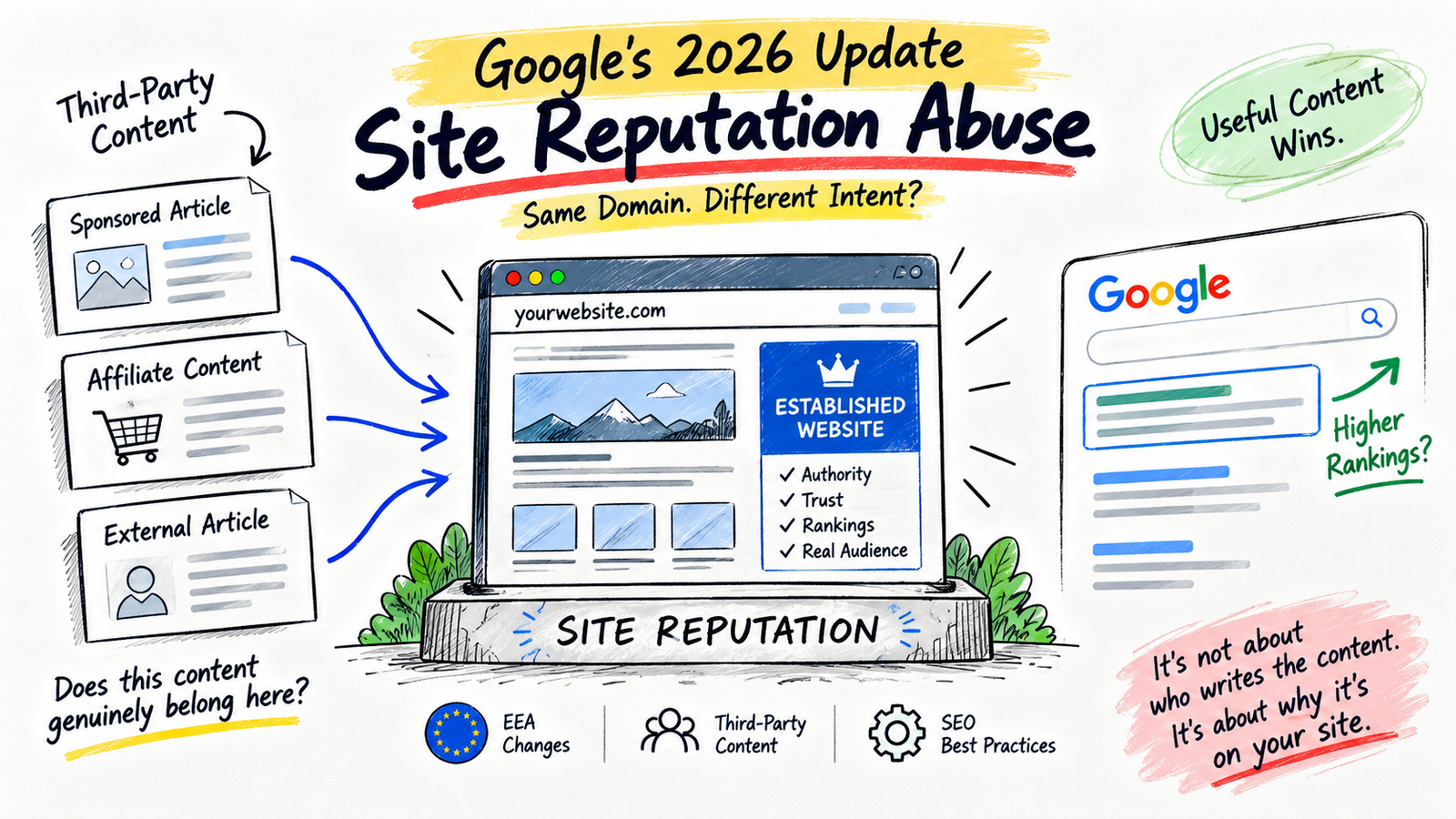
Google has updated its Site Reputation Abuse policy in August 2026.
But no, Google isn’t saying goodbye to third-party content just yet.
So, what actually changed?
The update changes how Site Reputation Abuse manual actions affect Search results for users in the European Economic Area (EEA). But the bigger story is still about how websites use third-party content—and whether that content genuinely belongs there.
For website owners, publishers, and SEOs, the question is pretty simple: Is your content earning its place on your website, or is your website’s reputation helping it get there?
What Is Google Site Reputation Abuse Update?
Let’s start with the basics.
Imagine you’ve spent years building a website. You publish useful content, earn links, build trust, and slowly become a familiar name in Google Search.
Then someone comes along and says:
“Great website. Can we use some of that SEO power?”
That’s where things can get interesting.
Google Site Reputation Abuse is about third-party content being published on an established website mainly to take advantage of that website’s existing ranking signals.
Google introduced this policy to tackle situations where external content gets an unfair SEO advantage simply because it is sitting on a stronger domain.
But here’s the part many people miss
Third-party content isn’t automatically bad.
A freelancer can write an article for you.
An industry expert can contribute to your publication.
A news website can publish syndicated content.
A forum can have user-generated content.
None of these automatically means Google is reaching for the penalty button.
The important question is why the content is there.
If it genuinely helps your audience, that’s one thing.
If it’s there mainly because your domain can help it rank, that’s a very different story.
So, What Changed in August 2026?
Google announced the update on August 28, 2026, with the new enforcement approach beginning August 30. You can read the official Google announcement for the full details.
The main change is about where the searcher is located.
Outside the EEA
When Google applies a Site Reputation Abuse manual action, the affected part of the website can be impacted in Search results.
The rest of the website isn’t automatically hit by that same action.
Inside the EEA
Here’s where things change.
The manual-action impact doesn’t apply to Search results shown to users in the EEA.
Instead, Google may separate the affected section so that it can eventually rank independently from the rest of the website.
And before anyone gets the wrong idea:
Europe hasn’t become a “do whatever you want” zone.
The policy still exists.
Google has simply changed how the enforcement works for EEA Search results.
Does Third-Party Content Violate Google’s Policy?
No.
And this is worth saying twice because it’s easy to misunderstand.
Google isn’t saying:
“Someone outside your company wrote this, so it’s a problem.”
The issue is whether the content is published mainly to exploit the host website’s existing ranking signals.
So, hiring a freelancer?
Fine.
Publishing a useful expert contribution?
Fine.
Creating an unrelated content section mainly because your domain has strong SEO signals?
Now we’re having a different conversation.
The author’s identity isn’t the whole story.
The purpose is.
What Counts as Third-Party Content?
The definition is actually quite simple.
If the content is created by someone separate from the established website, it can be considered third-party content.
That could be:
- Freelancers
- External agencies
- Guest contributors
- White-label content providers
- Users
- Partner organizations
- Other businesses or individuals
So if your freelance writer sends you an article tomorrow, you don’t need to stare at it like it’s a Google manual action waiting to happen.
Just look at the bigger picture.
Does the content belong here?
What Does Site Reputation Abuse Look Like?
Let’s use an example.
Imagine a website that has spent years publishing medical information.
Its audience expects health advice, medical research, and expert commentary.
Then suddenly, the website starts publishing dozens of unrelated pages about online casinos.
Why?
If the main reason is that the medical website already has strong ranking signals and those signals can help the casino content rank, that’s exactly the kind of situation Google’s policy is designed to address.
Now compare that with a news website publishing legitimate syndicated news.
Both are third-party content.
But the reason for publishing them is completely different.
And that difference matters.
What About Guest Posts?
This is where the SEO panic usually starts.
“Wait. Are guest posts banned now?”
No.
Legitimate guest contributions aren’t automatically Site Reputation Abuse.
A publication can work with external writers, experts, and contributors.
The problem appears when third-party content is being hosted mainly to take advantage of the website’s existing ranking signals.
So before accepting a guest post, ask yourself:
- Is it relevant to my audience?
- Does it fit the website?
- Is there genuine editorial oversight?
- Does it add something useful?
- Would I publish it even if it had zero SEO benefit?
That last question is particularly useful.
If the answer is yes, you’re probably thinking about the content for the right reason.
What About Affiliate and Sponsored Content?
Here’s another place where things can get unnecessarily complicated.
Third-party, sponsored, or affiliate content isn’t automatically a violation.
Google’s documentation includes legitimate forms of syndicated content, editorial contributions, user-generated content, advertising, and affiliate content among situations that aren’t automatically inconsistent with the policy.
Again, the question comes back to purpose.
Are you creating something useful for your readers?
Or are you mainly thinking:
“Our domain has authority. Let’s use it.”
If the second answer is driving the strategy, it’s time to take another look.
What Happens If Google Takes a Manual Action?
If Google determines that your website violates its spam policies, you can receive a manual action through Google Search Console.
Don’t think of this as Google dropping a mysterious SEO bomb on your website.
The first step is much more practical:
Find the problem.
Look at the affected content.
Understand why it doesn’t meet the policy.
Fix the underlying issue.
Then, when you’ve cleaned things up, you can submit a reconsideration request through Search Console.
The goal isn’t simply to make the warning disappear.
The goal is to fix the strategy that caused it.
Can You Just Move the Content to a Subdomain?
Ah, the classic SEO escape plan.
“What if we just move it to a subdomain?”
Unfortunately, a new address doesn’t automatically create a new SEO reality.
Google’s spam policies warn against moving content around simply to bypass enforcement. Using subdomains, subdirectories, or other sites as a way to continue violating the policy can create even more problems.
So don’t just move the furniture.
Fix the room.
What Should Website Owners Do Now?
You don’t need to delete every article written by a freelancer.
You don’t need to panic because your website accepts guest contributions.
And no, you don’t need to rebuild your entire website this weekend.
Start with an audit.
Look at your third-party content and ask:
Is it relevant?
Would your audience actually expect to find this on your website?
Is there editorial oversight?
Are you reviewing the content properly, or simply publishing whatever arrives?
Does it provide real value?
Would the content still be useful if Google didn’t exist?
That’s a surprisingly good test.
Why was it published?
This is the big question.
If the main reason is:
“Our website can help this content rank.”
Stop there.
Take another look before publishing.
A Simple Site Reputation Abuse Checklist
Before publishing third-party content, ask:
- Is it relevant to our audience?
- Does it fit our website’s purpose?
- Is there genuine editorial involvement?
- Does it provide meaningful value?
- Is the third-party relationship clear?
- Would we publish it even without the potential SEO benefit?
- Is the content earning its place, rather than simply borrowing our site’s reputation?
If you’re comfortable with those answers, you’re moving in the right direction..
What Google Is Not Saying
et’s clear up a few things before the SEO rumours start running faster than the facts.
Google hasn’t banned third-party content or guest posts. Content written by freelancers, experts, or external contributors can still be published on established websites. The important question is why the content is being published and whether it genuinely belongs on the site.
Also, Site Reputation Abuse hasn’t disappeared in Europe. The August 2026 update only changes how the manual-action impact applies to Search results for users in the EEA.
And moving the content to a subdomain doesn’t automatically solve the problem. If you’re simply moving content to bypass Google’s policy, that can be considered circumvention.
In short, third-party content isn’t the problem. Using a website’s reputation mainly to help unrelated content rank is.
The Final Takeaway
Google’s August 2026 update isn’t telling website owners to stop working with freelancers, contributors, agencies, or partners.
It’s asking a much simpler question:
Does this content genuinely belong on your website?
Your website’s reputation took time to build. Don’t use it as a shortcut for content that doesn’t naturally belong there.
Publish useful content. Work with experts. Accept legitimate contributions. Give your audience a reason to read the page beyond the fact that your domain has authority.
Because good SEO isn’t just about asking:
“How can I make this rank?”
Sometimes, the better question is:
“Why should this rank here in the first place?”
And honestly, that’s a question worth asking before Google has to ask it for you.